India and its Identity and Documents Crisis
India is facing a massive document and identifier fragmentation crisis. The average Indian citizen and business exists across a sprawling spaghetti of identification numbers and documents: Aadhaar (managed by UIDAI), PAN (Income Tax), Passport (Ministry of External Affairs), Driving License (State RTOs via SARATHI), Voter ID (ECI), Ration Card (State PDS), GSTIN (GST Network), and DIN (Ministry of Corporate Affairs).
Every single transaction — from opening a bank account to incorporating a startup, renting a house, or taking a flight — requires verifying one or more of these documents. What follows is a recurring cycle of redundant KYC verification: paper submissions, scanned PDFs, e-KYC calls, and manual reviews.
While the government’s centralized platforms have attempted to bridge these gaps, the infrastructure has reached its limits. We need a fundamental shift in how digital trust, identity, and documentation are designed in India.
The Limits of Centralized Digitization: The DigiLocker Bottleneck
DigiLocker was a massive step forward. It allowed citizens to store digital copies of their documents and fetch them on demand. However, architecturally, DigiLocker is a centralized API aggregator, not a decentralized trust system. This model has three major architectural limitations:
- Point-to-Point Database Dependency: DigiLocker does not store your files; it queries the issuing authority’s database in real time. If the Ministry of Corporate Affairs, CBSE, or a regional State RTO server experiences downtime, DigiLocker cannot fetch or verify your document.
- Centralized Tracking & Privacy Exposure: Every time you request a document to verify your identity (e.g., at an airport gate using DigiYatra or during a bank KYC check), a centralized system logs which document was accessed, by whom, and when. This creates a centralized audit trail of a citizen’s movements and financial activity.
- No Offline Cryptographic Verification: Verification relies on scanning a QR code or fetching a payload from a live server. Without a live internet connection and access to the issuer’s centralized API, verifying the authenticity of the document is impossible.
The Architectural Solution: W3C Decentralized Identifiers (DIDs) & Verifiable Credentials (VCs)
Rather than building more centralized API bridges between legacy databases, India must transition to a standardized trust framework using W3C Decentralized Identifiers (DIDs) and Verifiable Credentials (VCs).
In this architecture, trust is moved from the server to the data itself:
UIDAI: The National Registry Owner & Operator
As the custodian of India’s foundational identity stack, the Unique Identification Authority of India (UIDAI) must be the sole owner and operator of the national decentralized identity registry.
In this role, UIDAI does not store, issue, or track a citizen’s specific certificates or credentials (which remain stored privately on the citizen’s own device). Instead, UIDAI acts as the core enabler, providing the secure infrastructure, APIs, and standardized protocol that allows central/state government departments, private organizations, and third-party developers to issue, consume, and verify verifiable credentials utilizing DIDs. By operating this registry and enablement layer, UIDAI guarantees national sovereignty, strict security auditing, and a standardized source of truth for resolving issuer keys.
1. The Issuer (Government/Private Organizations)
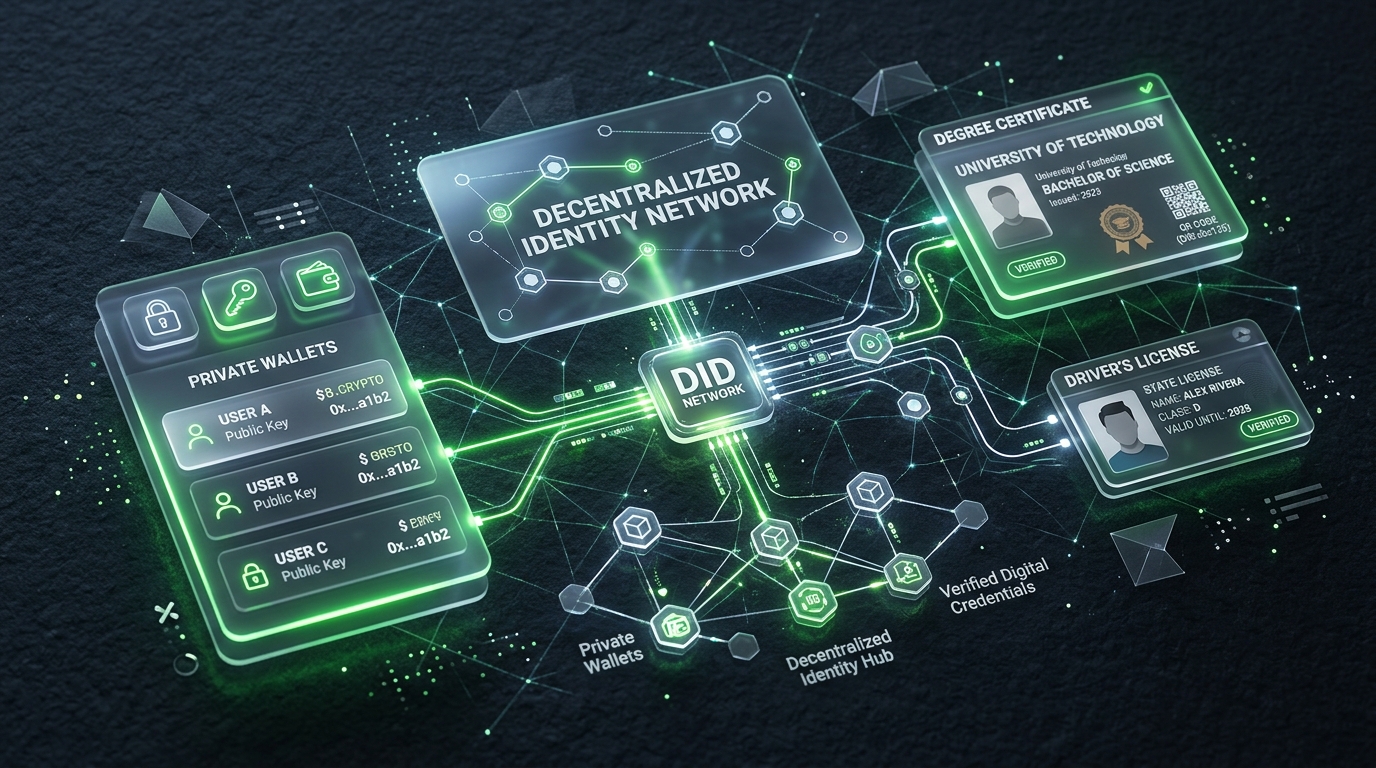
The issuing authority (e.g., a university, RTO, or DPIIT) compiles the credential data (e.g., a degree, a license, or a startup registration certificate). The issuer cryptographically signs this data using its private key, generating a Verifiable Credential (VC).
2. The Holder (The Citizen or Business)
The VC is sent directly to the citizen’s secure digital wallet on their local device (such as their phone or local storage). The citizen has full custody of the data. No centralized database stores their combined folder of documents.
3. The Verifier (Banks, Gates, Employers)
When the citizen needs to prove their credential, they present the VC to the verifier (e.g., sharing it offline via Bluetooth or displaying a local QR code). The verifier checks the cryptographic signature on the credential against the Issuer’s public key, which is resolved from a public registry.
Critical Advantage: The verifier does not need to call the issuer’s database, and the issuer never knows when, where, or to whom the citizen presented the credential.
Selective Disclosure & Zero-Knowledge Proofs (ZKP)
One of the greatest security breakthroughs of a DID/VC architecture is selective disclosure. Under our current system, if a security guard at a building needs to verify that you are over 18, you show them your Aadhaar card. In doing so, you reveal:
- Your full name
- Your exact date of birth
- Your home address
- Your unique 12-digit Aadhaar number
- Your photo
This is a massive privacy violation and a goldmine for identity theft.
With a DID-based Verifiable Credential, you can generate a Verifiable Presentation (VP) utilizing Zero-Knowledge Proofs (ZKP). Your wallet mathematically proves to the verifier that:
- You possess an Aadhaar card issued by UIDAI.
- The age calculated from that Aadhaar card is greater than or equal to 18.
The verifier receives a simple “YES” or “NO” cryptographic proof. They never see your date of birth, your address, or your Aadhaar number.
Integrating India’s Public Key Infrastructure (PKI) & MeitY’s Vishvasya Stack
We do not need to build a new network from scratch. India already has the two foundational pillars required to deploy this at scale:
1. The National Blockchain Framework (NBF) & Vishvasya Stack
The Ministry of Electronics and Information Technology (MeitY) recently launched the Vishvasya-Blockchain Technology Stack, a Blockchain-as-a-Service (BaaS) platform deployed across geographically distributed National Informatics Centre (NIC) data centers.
Instead of hosting a public, unregulated ledger, the Vishvasya stack acts as the permissioned decentralized anchor. Government agencies and certified publishers publish their DID Documents (which contain their public keys, cryptographic capabilities, and endpoints) to this secure ledger. This acts as the decentralized “single source of truth” for verifying issuer keys.
2. India’s Established Certifying Authority (CCA) Infrastructure
India has a highly robust, legally valid PKI managed by the Controller of Certifying Authorities (CCA). Licensed Certifying Authorities (such as eMudhra, CDAC, and NSDL) issue Digital Signature Certificates (DSC) to organizations and individuals.
The UIDAI registry platform will allow both government organizations and private businesses to enroll as verified entities on the registry using these existing DSCs. To register, an organization signs their DID Document using their valid Certifying Authority-issued certificate, automatically proving their legal identity. This allows the private keys used to sign issued Verifiable Credentials to be linked directly to these CCA-approved certificates, ensuring that a DID-signed credential carries the same legal validity under the Information Technology Act, 2000 as a physical document signed with a wet-ink signature or a DSC USB token, requiring zero regulatory updates.
High-Impact Use Cases & Global Verification
Applying a DID-based Verifiable Credential architecture immediately solves some of the most complex, high-fraud, and slow-moving verification challenges in India and globally:
1. Educational Qualifications & Academic Verification
Degree forgery and fake credentials are massive global issues. Under a W3C DID model:
- Issuance: Universities and school boards (CBSE, state boards) issue degree certificates, mark sheets, and transcripts as digital Verifiable Credentials signed by the institution’s DID.
- Verification: When a graduate applies for a job locally or a visa internationally, they present their VC. The employer or foreign embassy can verify the degree’s validity and the university’s accreditation in milliseconds. This completely eliminates the need for expensive, slow, third-party manual background verification checks.
2. Professional Licensing (Medical Practitioners, Engineers, CAs)
Licensing boards (like the National Medical Commission (NMC), Bar Council, or ICAI) currently maintain records in legacy, siloed databases. It is difficult for patients or employers to verify professional credentials instantly:
- Issuance: Licensing boards issue professional practice certificates as VCs tied to the practitioner’s DID.
- Verification: When a doctor is hired by a hospital, or presents credentials to practice internationally (e.g., NHS in the UK or medical boards in the US), they can share their digitally signed professional license VC. The verifying institution checks the signature and active status against the board’s public key in the UIDAI registry. If a license is suspended, the board updates the registry, which immediately revokes the credential.
3. Police Verification & Background Checks (International Immigration & Visas)
Securing a Police Clearance Certificate (PCC) is a major bottleneck for citizens moving abroad for employment, study, or permanent residency. Currently, this involves physical letters, stamps, and manual processing:
- Issuance: Local state police departments or passport offices issue clean-record verification status as a DID-signed Verifiable Credential.
- Global Interoperability: Because the credential conforms to W3C open standards, foreign consulates, immigration departments (like US CIS, Canadian IRCC, or UK Home Office), and multinational corporations can verify the authenticity of the background check instantly. This bypasses the tedious embassy validation, apostille, and physical legalization loops.
4. Corporate KYC & Signatory Verification
Sign all corporate registrations, GSTINs, and Director details (DIN) as VCs. When a business opens a corporate bank account or signs an agreement, they present these credentials. The bank verifies their active status and signatory authority instantly, reducing the corporate onboarding timeline from weeks to minutes.
5. Land, Vehicle, & Property Ownership Records
Transacting real estate or vehicles in India currently involves dealing with high rates of title forgery, ownership disputes, and multiple disconnected registration registries (RTOs for vehicles, sub-registrar offices for land).
- Issuance: State revenue departments and RTOs issue land title deeds, property registry certificates, and vehicle registration cards (RCs) as signed Verifiable Credentials.
- Immutable Ownership Trails: When a property or vehicle is sold, the transaction is cryptographically signed by the seller (relinquishing ownership) and counter-signed by the registrar. This generates an immutable, verifiable chain of custody (history trail). Banks offering home or auto loans can instantly verify the complete, uncorrupted ownership history and active lien status in seconds, eliminating manual title search delays.
The Credential Lifecycle: Issue, Consent, Verify, & Revoke
The movement of credentials between organizations and citizens is defined by a clean, four-stage cryptographic lifecycle. Rather than requiring departments and private companies to host complex database endpoints, UIDAI operates this registry and protocol as a centralized Software-as-a-Service (SaaS) platform:
- Issue: An issuing entity (like a board or council) signs the credential data. They push this verification state to the UIDAI SaaS ledger via API, delivering the signed Verifiable Credential (VC) directly to the citizen’s secure local wallet.
- Consent: When a citizen needs to verify themselves, the requesting organization triggers a query. The citizen gets a granular, device-level consent prompt (e.g., “Share medical license status only?”). Upon approval, the wallet generates a Verifiable Presentation (VP) proving compliance without leaking secondary metadata.
- Verify: The verifier receives the VP and checks the cryptographic signature using the issuer’s public key (resolved via the UIDAI SaaS registry). This requires zero API queries back to the issuer’s database, resolving instantly.
- Revoke: If a credential (like a professional license) must be revoked, the issuing organization logs into the UIDAI SaaS portal and registers the credential hash as revoked on the public ledger list, instantly invalidating future checks.
Migration: Simple Bulk Issuance & Backfilling
A common hesitation when proposing new national identity standards is the transition cost: how do we migrate decades of legacy paper and digital records?
Fortunately, backfilling and issuing Verifiable Credentials from existing legacy systems is a trivial engineering challenge that can be completely automated. Because a Verifiable Credential is fundamentally just a structured JSON/JSON-LD document signed with a private key, organizations do not need to replace or re-architect their existing databases (SQL, Oracle, DB2, Postgres).
Instead, departments and companies can deploy a lightweight issuer microservice (a “Credential Agent”) that connects directly to their legacy databases:
- Batch Query: The agent queries legacy tables (e.g., historical graduation lists, property records, active medical licenses) in batches.
- Template Mapping: It parses each database row and maps the fields/columns to the standardized DID credential template.
- Automated Signing: The agent bulk-signs each record using the organization’s secure DSC-backed key hosted in a HSM or cloud key manager.
- Registry Update: It publishes the credential hashes or schemas to the UIDAI SaaS ledger.
With this approach, an academic board or land registrar can easily issue millions of historical credentials in a single weekend run, making the migration path seamless, cost-effective, and fully compatible with existing legacy database backends.
Democratizing Access: Economics & Alignment of Incentives
Rather than locking this infrastructure behind bureaucratic gateways, high licensing fees, or administrative hurdles that exclude average-sized organizations, the UIDAI platform must remain open and accessible to any developer, school, local cooperative, or startup.
To fund and accelerate this ecosystem, UIDAI should implement a sustainable, aligned economic model:
- Pay-per-Use API Model: Instead of complex subscription fees, verification queries (e.g., a bank verifying a PAN status, or an employer verifying a degree) are charged on a small, pay-per-use basis, similar to standard utility APIs.
- Issuer Incentives (The Credit & Wallet Model): Every time a verification check happens, a portion of the verification fee paid by the verifier is routed back to the issuer of that credential (e.g., the university or RTO) to reward them for maintaining clean data.
- Government Issuers: Earn credits within the UIDAI system that offset their own platform usage costs.
- Private Issuers: Receive direct financial payouts into their organizational wallet.
This transforms verification from an administrative chore into a lucrative revenue stream. Instead of resisting integration, organizations will naturally rush to digitize their legacy records and adopt DIDs to capture these verification rewards, driving adoption through economic gravity rather than compliance mandates.
The Future of DigiLocker: Evolving into a Decentralized Wallet
To make this a reality, DigiLocker does not need to be replaced — it needs to evolve.
Currently, DigiLocker is a gatekeeper, acting as a centralized intermediary. In the future, DigiLocker should transition into a truly decentralized digital identity wallet:
- Instead of hosting files or acting as a routing server, the DigiLocker app should run completely client-side, storing W3C Verifiable Credentials locally in the user’s secure enclave (protected by device biometrics).
- This means DigiLocker ceases to be a single point of failure or a centralized database. Even if the national DigiLocker servers are offline, citizens can still display, share, and cryptographically verify their credentials.
For this transition to succeed, UIDAI’s mandate must change: rather than building siloed, closed-loop applications, UIDAI must build a truly open, permissionless protocol. This protocol must provide open APIs, SDKs, and schema templates available equally to both government departments and private businesses.
By opening up the DID registry to private enterprise, any startup, bank, university, or corporation can immediately become an issuer, consumer, or verifier of credentials. Just as UPI succeeded because the government built an open network (allowing private players like PhonePe, Google Pay, and banks to build their own apps), the decentralized identity revolution in India will succeed when UIDAI opens the DID registry, turning DigiLocker from a closed portal into an open, sovereign ecosystem.
The Verdict
Decentralized identity is not a futuristic concept; it is the logical next step for India’s Digital Public Infrastructure (DPI). By combining the cryptographical power of W3C DIDs, the legal backing of India’s CCA PKI, and MeitY’s Vishvasya blockchain platform, we can resolve our identity and document crisis once and for all.
India has shown the world how to scale payment systems via UPI. It’s time to show the world how to scale secure, private, decentralized trust.